
Industrial facilities ask more of their walls than most buildings ever will. Sheetrock has to stand up to vibration, forklifts, temperature swings, washdowns, and constant traffic while still supporting safety and fire protection. When industrial or commercial drywall is treated like a simple finish instead of a critical part of the building, small drywall installation problems can turn into expensive headaches.
The good news is that most industrial drywall mistakes are avoidable with the right planning, materials, and drywall contractor. Here are five issues we see most often in plants, warehouses, and manufacturing environments—and how to steer clear of them.
How Poor Substrate Prep Leads to Drywall Failure
In an industrial space, sheetrock is only as strong as what it is attached to. If the substrate is weak or damaged, even a neat drywall installation can crack, bow, or fail long before it should. Rusted or bent studs, loose anchors in masonry walls, leftover fasteners, and hidden moisture all create an unstable base that shifts or breaks down over time. Those problems later show up as waves in the wall, cracks along seams and corners, or fasteners that pop through the finish.
A good industrial drywall contractor prevents this by inspecting the framing, fixing damaged studs, correcting moisture issues at the source, and cleaning away old materials so the board can sit flat on a solid, stable surface. Strong prep work is the first step in avoiding costly industrial drywall mistakes down the road.
Why Board Choice Matters in Industrial and Commercial Drywall
Not all drywall is the same, and using the wrong type of board is one of the most costly industrial drywall mistakes. Trouble often starts when standard drywall is used in wet or washdown areas where it is not designed to last. In other cases, non-rated board is installed where a fire-rated assembly is required, or light-duty board is placed in corridors and forklift aisles that see heavy abuse. On tall walls or loaded partitions, board that is too thin can flex, sag, and fail inspection.
To avoid these problems, the sheetrock in each area must match the conditions it will face. Moisture-resistant drywall belongs in washdown rooms and spaces prone to condensation, and fire-resistant drywall is needed wherever code calls for a fire-rated wall. In high-traffic, high-impact areas, abuse-resistant or impact-resistant boards are the best choice. An experienced industrial or commercial drywall contractor will review your layout and processes and then specify the right mix of boards for each zone.
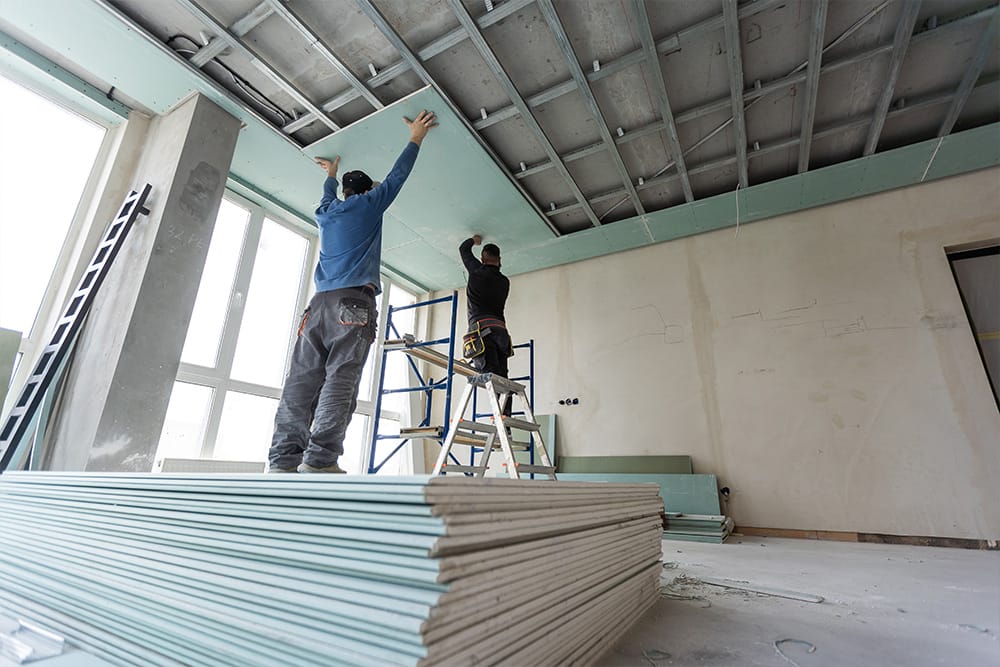
How Busy Areas Quickly Expose Drywall Installation Problems
Inside industrial facilities, walls are exposed to constant wear. Forklifts bump into corners, pallets scrape along surfaces, and carts and tools move down the same routes every shift. When detailing in these high-traffic areas is weak, damage builds up fast. Corners chip, edges crush, and scuffs and gouges appear near doors, loading docks, and storage areas. Even in a newer building, walls can start to look old and patchy.
The best way to avoid this is to build protection into the design. Corners and edges should be reinforced so they can handle bumps and scrapes without constant repair, guards or rails can shield walls in tight aisles and staging zones, and tougher finishes on vulnerable sections help resist marks and dents. Smart detailing keeps industrial drywall looking professional and extends the life of your investment.
How Building Movement Creates Cracks and Gaps
Industrial buildings move more than many people realize. Equipment vibrates during use, steel frames flex under load, and temperatures rise and fall with the seasons and the process. If an industrial sheetrock installation does not allow for this movement, cracks will follow. Long cracks can appear on big wall runs when expansion and contraction have nowhere to go, and gaps may open where walls meet ceilings or bulkheads.
Around openings, spider cracks can form as the board shifts against frames or supports, letting dust and fumes move into sensitive spaces and weakening fire-rated walls. To prevent these drywall installation problems, the wall system has to be designed to flex safely, with control joints on long walls and large ceilings and fastener patterns that follow manufacturer guidelines.
Why Shortcuts in Finishing Lead to Long-Term Problems
Even with the right substrate and board type, rushed finishing can undo an otherwise good industrial or commercial drywall job. Tight schedules sometimes push taping, sanding, and repairs to the side, but these steps are critical to the final look and performance. When joints are not taped or embedded well, lines and cracks show up over time. If too few coats of joint compound are used, seams and fastener heads stay visible, especially under bright or angled light.
Poor sanding leaves ridges and bumps, and quick patch jobs often show through paint or fail after a short time. A solid finishing process avoids these issues by taking enough time to build smooth transitions, let each coat dry, and correct flaws before paint goes on. Finished this way, industrial drywall becomes a durable, low-maintenance backdrop to daily operations instead of a constant source of complaints.
Industrial sheetrock installation is a core service for Process Equipment & Controls, not a side job. Our teams work every day in manufacturing plants, warehouses, and other demanding facilities, so we understand what your walls face. We know how to prepare substrates so drywall has a strong, long-term base instead of a weak backing that will fail, and we choose the right mix of standard, moisture-resistant, and fire-resistant drywall for each zone.
Our installers focus on careful details in corners, openings, and high-traffic areas so walls hold up to real-world use. We cut and align every sheet with precision and set fasteners to the proper depth to protect both strength and finish. Because PEC also provides millwrighting, rigging, industrial electrical, process piping, and other services, we know how walls and ceilings must work with the rest of your project, not fight against it.
When you choose PEC’s Interiors Division for industrial and commercial drywall, you get more than someone to hang board—you get a partner who treats every wall as part of your core infrastructure. If you are dealing with recurring drywall installation problems or planning a new project, schedule a consultation with Process Equipment & Controls today. Our industrial sheetrock installation experts can help you avoid costly industrial drywall mistakes and give your facility the durable, reliable interiors it deserves.