If you manage a plant, you feel the daily pressure to ship quality products, keep your team safe, and reduce downtime. Industrial control systems (ICS) tie those goals together. Think of ICS as the “nervous system” of your operation: sensors gather data, controllers make decisions, and actuators carry them out in real time. Done well, controls, process controls, and automation control turn a patchwork of machines into a predictable, high-performing system.
Below is a straight-talk guide to the business value of ICS, followed by practical cues for when to involve Process Equipment & Controls (PEC) and why teams across Georgia and the Southeast choose us for Electrical Controls and Automation.
An ICS is the combination of hardware, software, and standards that monitors and governs industrial equipment. Common building blocks include PLCs and PACs, HMIs, SCADA, field sensors, VFDs, robotics, and industrial networks. The point isn’t just control—it’s repeatability, traceability, and safe productivity at scale.
1
Automation control stabilizes cycle times and eliminates variation. Process controls hold setpoints for temperature, flow, pressure, level, and speed so each run looks like the last. The result is more units per shift with fewer reworks.
2
ICS detects drift before it becomes downtime. Alarms, interlocks, and condition monitoring prompt planned maintenance instead of surprise failures. That means fewer emergency calls, lower spare-parts spend, and better OEE.
3
Interlocks, e-stops, guarding, and functional safety PLCs reduce risk to people and equipment. Electronic signatures and audit trails support OSHA, NFPA 70E, and customer requirements. Good process controls also minimize waste and spills.
4
Dashboards surface the KPIs that matter: production rate, scrap, availability, and energy use. Your team can diagnose bottlenecks quickly and run data-driven experiments without stopping the line.
5
Modern ICS programs are modular. Recipes, parameters, and changeovers live in software, not in hardwired logic. You can add cells, reroute conveyors, and integrate new equipment without ripping and replacing.
6
Drives, soft starters, and closed-loop control trim peaks and cut idle losses. Utilities drop while uptime rises—a rare win-win.
Watch for these “symptoms” on the floor:
You want a partner who can design, build, and support the entire control stack—safely and on schedule. That’s our lane.
Electrical Controls, end-to-end
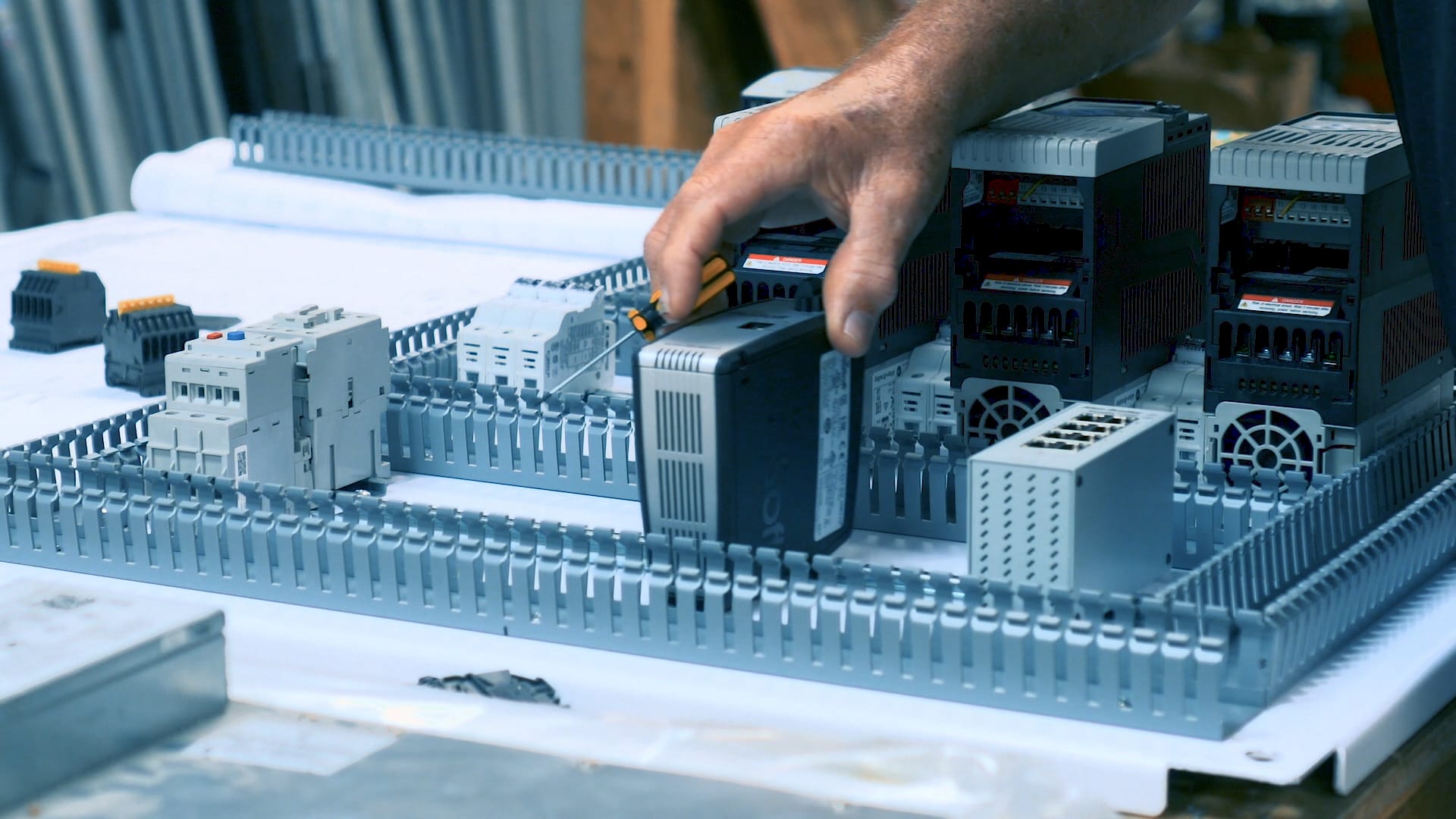
We design and build UL-compliant control panels, specify sensors and instrumentation, program PLC/HMI/SCADA, commission on site, and document everything. From MCC buckets and VFDs to safety circuits, our controls engineering team makes systems reliable and maintainable.
Process automation that scales
PEC integrates process controls across utilities, batching, packaging, and material handling. We standardize code libraries, tag naming, and alarm philosophies so future changes are simple. If you need a uniform approach across multiple lines or plants, we’ll make it happen.
Robotics and motion integration
From robotic picking to palletizing and small-parts assembly, we design cells, develop motion profiles, and connect them to upstream and downstream systems. With well-tuned drives and profiles, you get speed without beating up equipment.
Modernization without disruption
We migrate legacy platforms to supported PLCs, replace obsolete HMIs, and convert relay logic to code—often while the plant keeps running. Our method uses staged cutovers and I/O checklists to reduce risk.
Connected data, simpler decisions
We surface production, quality, and machine health data where it helps: HMIs on the floor and dashboards for leadership. That means fewer “gut call” decisions and faster root-cause analysis.
Lifecycle support and training
After startup, we stay with you. Remote support, PM checklists, spare-parts plans, and operator training keep gains locked in.
Teams often stumble when they over-customize code without shared standards. That makes future changes slow, fragile, and hard to support. Security gets overlooked too—basic steps like network segmentation and role-based access aren’t optional. Alarm floods also shouldn’t be treated as “normal.” Rationalizing alerts ensures real problems stand out.
Skipping documentation and backups turns routine fixes into emergencies. And when features roll out without operator training or change management, confusion and rework follow, along with avoidable downtime.
If you’re weighing new controls, process controls upgrades, or a plant-wide automation control roadmap, let’s talk. PEC’s Electrical Controls and Automation teams turn complex operations into simple, safe, repeatable systems.
Explore our Electrical Controls services and our Automation & Robotics capabilities on our website or contact us today to learn more. Whether you’re improving one line or modernizing an entire facility, we have the solutions and support you need.