
A millwright is a skilled tradesperson who installs, assembles, aligns, maintains, dismantles, and relocates industrial machinery. That is the short answer. The full answer is precision: millwrights set heavy equipment to tolerances measured in thousandths of an inch, level and align rotating machinery, and make sure a production line runs the way it was engineered to run. To put it simply millwright work is the craft of putting heavy machinery exactly where it belongs and keeping it there.
If you want to know what is a millwright, what does a millwright do, or how to become a millwright, this guide covers all of it: the day-to-day work, how the trade differs from rigging and maintenance, the industries that hire millwrights, what the jobs pay, and when a facility should bring in professional millwright services.
The dictionary millwright definition reads something like this: a craftsperson who installs, maintains, and repairs machinery in industrial settings. The meaning of millwright traces back centuries, to the wrights who designed, built, and repaired water mills and grist mills by hand. A wright was a builder, a mill was the most complex machine of its era, and the millwright was the person who could make one run.
The old mills are mostly gone, but the definition of millwright work has kept its core. Where the old millwright fit wooden gears by eye, today’s millwright aligns a motor to a gearbox with a laser system and reads tolerances off an engineering drawing. If you had to define millwright in modern terms, it would be this: the mechanical trade responsible for the precise installation, alignment, repair, and relocation of industrial machinery.

Ask ten plant managers what a millwright does and you will hear ten versions of the same answer: the mechanical work nobody else on site can do to tolerance. What do millwrights do in practice? The work falls into several broad buckets, and most millwrights move between all of them over the course of a year.
New equipment rarely arrives ready to run. Millwrights receive it, set anchor bolts and baseplates, assemble components, grout foundations, and bring the machine to the exact elevation and position the drawings call for. Along the way, they check for soft foot, confirm anchor torque, and record as-set elevations so the commissioning team starts from a known baseline. On a new production line, the quality of that installation work often determines whether commissioning goes smoothly or drags on for weeks.
Alignment is the heart of the trade. Using optical instruments, lasers, and dial indicators, millwrights align motors to gearboxes, couplings to shafts, and conveyor sections to one another within thousandths of an inch. Misalignment is one of the most common causes of premature bearing and seal failure, so precision here directly protects uptime and maintenance budgets.
When a facility reorganizes a line, consolidates plants, or moves equipment into a new building, millwrights handle the teardown, transport preparation, and reinstallation. They document machine condition, match-mark components, coordinate lifts with rigging crews, and then re-level and re-align everything at the destination so it starts up like it never moved.
Scheduled shutdowns compress months of mechanical work into a few days, and millwrights carry much of that load: pulling gearboxes, replacing rolls and bearings, rebuilding drive assemblies, and correcting alignment drift. When equipment fails without warning, a millwright is often the first trade called, because the fastest path back to production usually runs through mechanical repair done right the first time.
Between the big installations and the emergencies sits steady preventive work: inspecting couplings and drives, checking alignment on critical rotating equipment, replacing wear components on schedule, and documenting machine condition over time. Facilities that fold millwright checks into their maintenance program tend to catch problems while they are still a parts order instead of a production stoppage.
A typical millwright job description asks for a blend of mechanical aptitude, applied math, and field judgment. The toolbox runs from feeler gauges to laser alignment systems, and the settings run from sanitary food plants to active construction sites.
Core responsibilities in most millwright jobs include:
Beyond the technical list, millwright job requirements almost always include a strong safety record, comfort working at height and in tight quarters, and the ability to work from incomplete information when a machine’s documentation disappeared decades ago. The best millwrights combine a machinist’s precision with a builder’s practicality.
Riggers specialize in moving heavy loads: calculating weights and centers of gravity, selecting slings and hardware, and directing crane lifts. Millwrights and riggers work side by side on machinery moves. The rigger gets the machine safely to its footprint, and the millwright makes it run there. Many industrial contractors, PEC included, field crews trained in both disciplines because the two scopes hand off constantly.
Maintenance mechanics keep equipment running day to day inside a single facility, handling lubrication routes, belt changes, and routine repairs as part of a plant’s industrial maintenance program. Millwrights typically come in for the heavier, higher-precision work: new installations, major rebuilds, laser alignment, and relocations. Plenty of millwrights start out as maintenance mechanics, and the two trades share a language and a toolbox.
One more comparison comes up often: millwright versus machinist. A machinist makes precision parts in a shop, and a millwright installs and maintains the machines those parts go into. The two trades overlap in measurement skill and share a respect for tolerances, which is why full-service industrial contractors tend to keep both under one roof.

Anywhere machinery has to be set, aligned, or moved, millwrights have work. Industrial manufacturing is the trade’s biggest employer: automotive plants, steel and paper mills, plastics operations, and fabrication facilities all depend on millwrights for installations, rebuilds, and line moves.
Food and beverage plants add sanitary requirements to the mix, with stainless equipment, washdown environments, and USDA and FDA compliance shaping how the work gets done. Power generation, aggregates and mining, sawmills, and grain handling round out the traditional base of millwright jobs, and each has its own rhythms of outage work and seasonal maintenance.
Bio-science manufacturing is a smaller but demanding niche, where documentation discipline and cleanroom awareness matter as much as mechanical skill.
The fastest-growing demand is newer: data center construction. Hyperscale campuses need mechanical crews who can set generators, air handlers, and skidded equipment on unforgiving schedules alongside twenty other trades.
Contractors who can pair millwrights with electricians and steel crews have a real edge in that market, and so do the tradespeople who can keep mission-critical pace on those sites.
The honest answer is almost anything with a rotating shaft or a foundation. Common equipment in millwright work includes:
On a modern plant floor, much of this equipment ties into PLCs and robotic cells, so millwrights increasingly work alongside automation and robotics teams during installations and startups to make sure the mechanical and controls scopes land together instead of in sequence.
Part of what defines the trade lives in the toolbox. The precision end includes dial indicators, micrometers, feeler gauges, optical levels, and laser shaft alignment systems that read misalignment in thousandths of an inch. Layout work leans on machinist levels, squares, transits, and string lines, because a machine set out of level on day one will fight its operators for years.
The heavier end of the kit covers hydraulic jacks and torque equipment, machine skates, gantries, come-alongs, and turnbuckles for controlled moves, plus welding and cutting gear for fabricating shims, brackets, and guards on the spot. Increasingly, millwrights also carry vibration analyzers and thermal imagers, using condition data to catch a failing bearing before it turns into an unplanned outage.
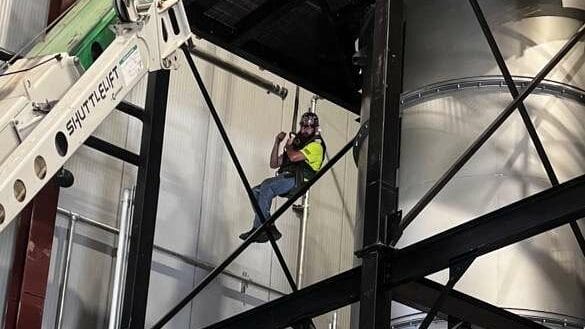
There is no single gate into the trade, but most paths run through the same stages. Formal degrees are optional in this trade; what counts are logged hours, demonstrated skill, and a reputation for showing up.
Wondering how to become a millwright? Here is the route most tradespeople follow.
Entry requirements are straightforward: a high school diploma or GED, solid shop math, mechanical aptitude, and the physical ability to handle fieldwork. Prior experience in welding, machining, auto repair, or general construction helps. So does a serious safety mindset, because millwrights work around suspended loads, stored energy, and rotating equipment every single shift.
A millwright apprenticeship pairs paid on-the-job training with classroom instruction, typically over three to four years. Apprentices learn layout, rigging fundamentals, precision alignment, welding, and hydraulics while logging thousands of field hours under experienced journeymen. Union programs, technical colleges, and employer-sponsored training all lead to the same destination, and the best program is usually the one that puts you on real job sites fastest.
So what is a journeyman millwright? A journeyman is a millwright who has completed an apprenticeship or equivalent field hours and can perform the full scope of the trade without supervision: installations, alignment, rebuilds, and relocations. Journeyman status is the trade’s credibility marker. It usually brings higher pay, more responsibility, and the opportunity to lead crews and train the next round of apprentices.
The learning does not stop at journeyman. Welding certifications, crane and rigging qualifications, laser alignment training, and vibration analysis all raise a millwright’s value, and specialists who can work regulated or mission-critical environments are in especially short supply. If you are building that kind of career in the Southeast, PEC is always looking to meet skilled tradespeople. Visit our Join Our Team page to see where you might fit.
Millwright jobs pay well relative to the cost of entry, since apprentices earn while they train instead of taking on tuition debt. Federal labor statistics puts the national median millwright salary in the low $60,000s per year, and experienced journeymen, shutdown specialists, and crew leads commonly earn more, especially with overtime during outages and turnarounds. Pay varies by region, industry, and credential mix, so treat any single millwright jobs salary figure as a midpoint rather than a ceiling. Apprentices start below journeyman scale and step up on a published schedule as hours and coursework accumulate, which makes the earnings path unusually predictable.
The outlook is steady, and in the Southeast it is arguably better than steady. Reshored manufacturing, food processing growth, and a wave of data center construction all lean heavily on the mechanical trades, while the experienced millwright workforce is retiring faster than it is being replaced. For people entering the trade, that math is favorable. For facilities that need the work done, it is one more reason to line up a proven contractor before the schedule gets tight.
For the right person, yes. The trade offers strong pay without a four-year degree, work that changes from site to site, and the particular satisfaction of starting up a machine you set with your own hands. Demand is durable because the work cannot be outsourced or done remotely; somebody has to be standing at the baseplate.
The honest trade-offs: the work is physical, shutdown schedules can mean long stretches of nights and weekends, and the standards are unforgiving because a misaligned coupling does not care how tired you were.
People who came up through shop classes, farm equipment, or general construction tend to take to it naturally. Advancement is real, too. Journeymen move into foreman and superintendent roles, shift into maintenance planning, or specialize in high-demand niches like laser alignment and vibration analysis. If that describes you, millwright work rewards the effort for an entire career.

When contractors talk about millwright services, they mean the trade delivered as a package: trained crews, supervision, tooling, rigging coordination, and single-point accountability for the mechanical scope on your site. Most facilities do not staff enough millwrights to cover a major installation or move, so they bring in a contractor for the peaks.
A capable millwright contractor brings more than labor. Expect help with sequencing and pre-planning, coordination with the electrical and controls trades, rigging plans for the heavy picks, and documented alignment readings at turnover. The difference shows up as fewer surprises at startup and fewer callbacks after. A few scoping questions will tell you whether it is time to make that call:
If you answered yes to any of these, a conversation costs nothing and usually surfaces sequencing issues while they are still cheap to fix. Let’s Talk and we will help you scope it.
PEC has spent 30+ years building one of the Southeast’s deepest benches of millwright talent, and our millwright and rigging services cover the full arc of the trade: machinery installation, precision alignment, plant moves, shutdown support, and emergency response, including 24/7 on-call dispatch when a breakdown will not wait for business hours. All of it is backed by a 70,000 sq ft fabrication facility in Covington, GA.
What sets our crews apart is what stands behind them. Our millwrights work alongside PEC’s own electricians, PLC programmers, fabricators, and structural steel crews, so one accountable team can carry scopes that would otherwise take three or four subcontractors. Fewer handoffs, no finger-pointing, and a schedule that holds.
Whether you are planning an installation, staring down a plant move, or simply want a millwright contractor you can call before you need one, we are ready to roll up our sleeves. Explore What We Do, or Let’s Talk and tell us about the project.